How AI decides which brands it recommends
How does ChatGPT decide which brands to mention and recommend? A plain-language explanation of language models, memory, live search and why testing once tells you little.
Have you ever wondered how ChatGPT and other AI assistants decide which names to mention in an answer? You’re not the only one. More and more brands are asking: how can I tell whether AI recommends my competitors instead of my brand? And above all: what can I do to get recommended more often? Understanding how it works is the foundation of every good AI Search strategy.
In this article I explain in plain language how AI arrives at a recommendation. You’ll read how searching with AI differs from Google, how a language model builds its answer, why it matters whether a model answers from memory or searches live, and why testing once tells you little. In part 2 you’ll read what you can do to get recommended more often.
Note: when I mention ChatGPT, you can read Gemini, Copilot, Claude or any other AI platform as well. They work on the same basic principle, even though the end results often differ.
How we searched until recently
Google works with an index, a gigantic copy of millions of websites. You type in a specific search term and get a list of links back, in order of relevance. That order is called the ranking. If you’re at the top for the right term, people click through to your site and some of them buy something. SEO agency happy, you happy and Google too, because on top of all those organic clicks it earns billions in advertising revenue on the same search terms.
The only one who had to work hard was the consumer. They opened several highly ranked (or well-known) providers, figured out which one fit their situation best, checked the reviews and only then chose. It took hours, but there was no alternative, so we thought it was perfectly normal.
Now you have a conversation
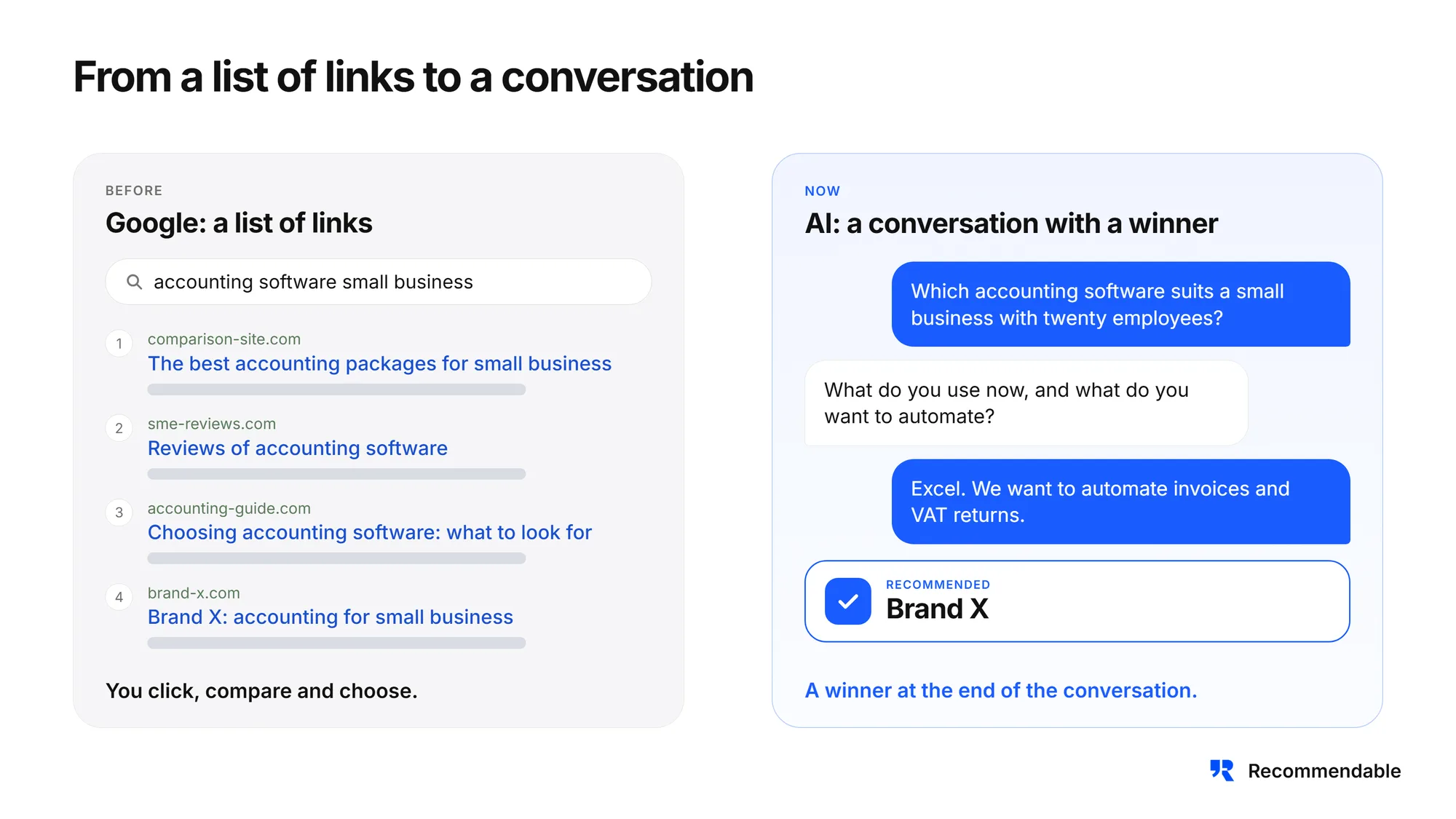
That changed with the arrival of ChatGPT. Instead of searching, clicking and comparing endlessly, you simply have a conversation. Say you’re looking for new accounting software for your small business with twenty employees. You describe your situation, get an answer, ask follow-up questions and end up with one or two brands that the assistant thinks fit you best. Chances are you then check the provider’s site or read a few reviews to decide whether it’s a reliable and suitable party, and then you choose.
Remember that word for now: conversation. Nobody, and I mean nobody, asks just one question and immediately calls the top name on the list. We have whole conversations with the platform before we make a choice. What’s said in the first answer matters within a conversation, but it’s never the end goal.
So search is shifting from a list of links to a conversation with a winner at the end. You used to have to rank high. Now you have to be recommended at the end.
We still search Google ‘the old-fashioned way’. Anyone who claims otherwise is wrong, or says it because it’s commercially more interesting ;)
Google Search is and remains a hugely important part of online searches. But for complex purchases, where you have to weigh and compare, searching with AI is growing fast. And before long we may let AI agents hold those conversations entirely, but I’ll save that for a later piece.
How does an LLM arrive at an answer?
ChatGPT, Gemini and Claude are LLMs: Large Language Models. At their core, every LLM is a prediction machine. Trained on enormous amounts of text, it learned which words, concepts and names belong together. For every question it uses that to estimate the most likely continuation of the sentence: it predicts what the next word should be.
A recommendation is therefore the most likely name in that context. An LLM has no brand preference: it simply repeats what it comes across everywhere.
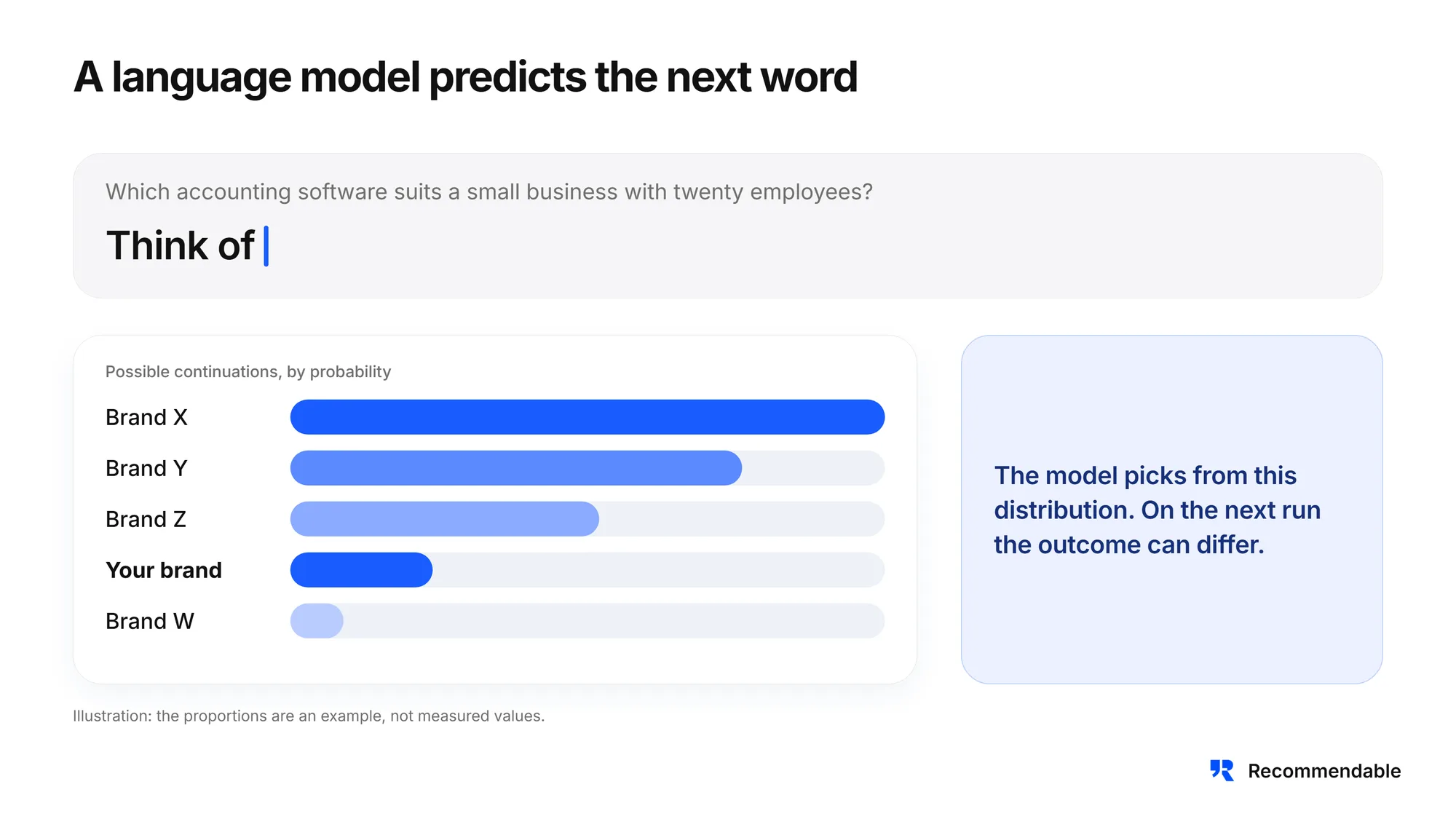
Say you ask: “Which accounting software suits a small business with twenty employees?” Then the answer starts with something like: “think of brand X and brand Y.” Those are the names that appeared most often near that topic in the texts the model learned from. This is how the model builds a profile of every brand: what does it stand for, which topic does it belong to, what do people say about it? Of course an AI has no opinion or real ‘image’ of its own; under the hood this profile consists purely of mathematical weights and words that statistically often occur together (co-occurrence). And it learned from the whole internet, not just from your site and those of your competitors.
AI reputation per brand
That image lives in the model itself (and so differs per model and platform). You can think of it as your brand’s reputation in the memory of the AI platform. Which associations does it link to your brand, and how strong are they? If the image is strong and correct, your name easily rises to the top in the right situations. If it’s vague or outdated, or you’re simply unknown, the model doesn’t mention you, or mentions you less often, or tells things about you that are (no longer) true.
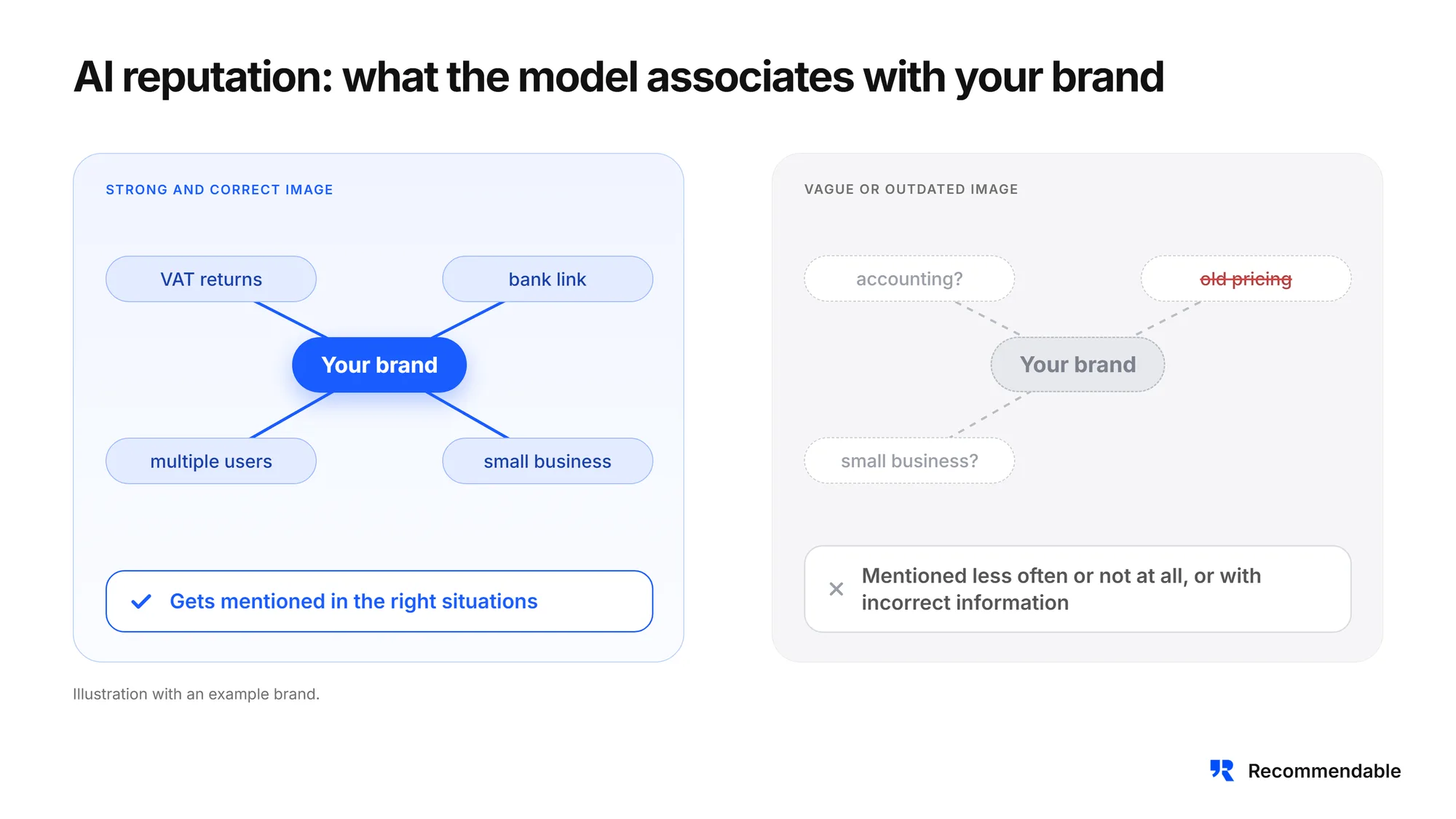
Insight into your AI reputation is therefore worth its weight in gold.
How AI Search differs from classic Google search
Google Search, and with it ‘classic SEO’, is deterministic at its core. Deterministic means: same input, same output. Of course factors like your location and search history play a role in what you see, but in general it holds: same input, same output. For a given search query, Google will in principle return a fixed set of results at a given moment.
The ranking can differ, but it’s based on fixed algorithms, signals and an indexed snapshot of the web. So you can say quite sensible things about which website scores high on which search term. Rankings change when the underlying factors change.
AI assistants give the most probable answers.
AI Search is probabilistic, in other words based on probability. Language models like ChatGPT work with probabilities: for every next word they choose from a distribution of possibilities. Even with the same question, the answer can differ per run. So there is no fixed ranking being looked up. AI models also take a lot of user context into account (what you’ve already shared in the past) and every platform and every version of a model works slightly differently on the back end. But they are all probabilistic.
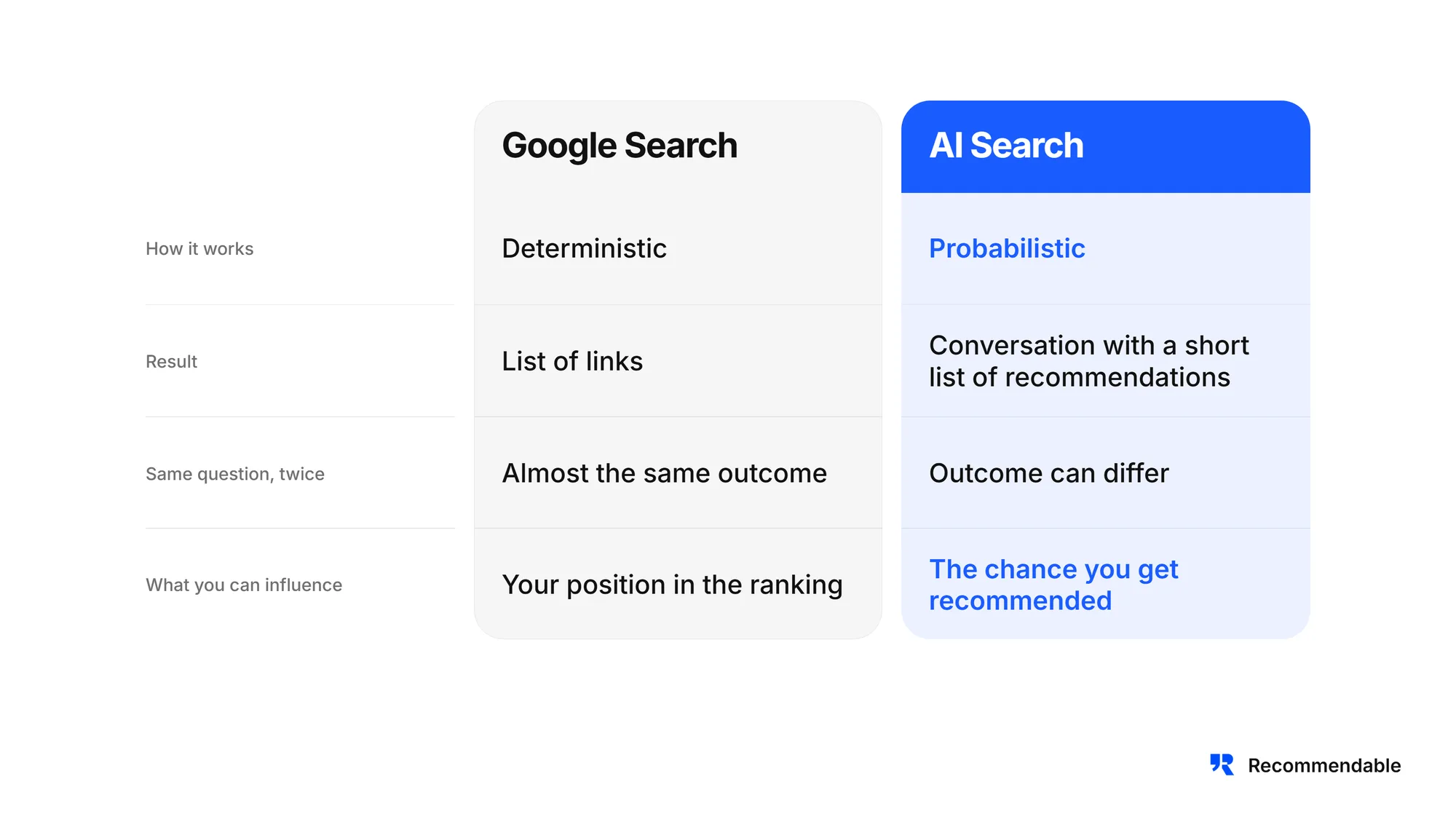
What you should remember is this: in AI Search there is no fixed ranking that you can ‘push up’.
The goal of AI Search optimization is simply everything you do to increase the chance that you get recommended.
Memory versus live search
When ChatGPT launched, it had no live search function yet. All answers came from its memory: they sucked up the whole internet and the model learned from it. But that also meant you couldn’t look up current information, simply because the LLM didn’t have it.
That’s different today. Models now often refine their first assumption through live search. So first there’s an answer from memory, and then the model can search the web to add to or adjust that answer. Whether that live search happens depends on the question, the platform and the model. Searching costs money, which immediately answers the question of why they don’t always search to refine the answer.
How often they search live differs per type of question and model, but our own data at Recommendable shows that ChatGPT, Gemini and Claude generally search on around 85 to 95% of prompts. Perplexity always searches, because it has no memory mode.
Query fan-out
With live search, something happens that is called query fan-out. The LLM takes your main question apart, cuts it into several very specific sub-questions, searches for information that way, summarizes it in a flash and gives an answer.
An example to illustrate: for the main question “Which accounting software suits a small business with twenty employees?” the model can send out sub-questions such as “accounting software small business price comparison” and “reviews of accounting packages for small business”.
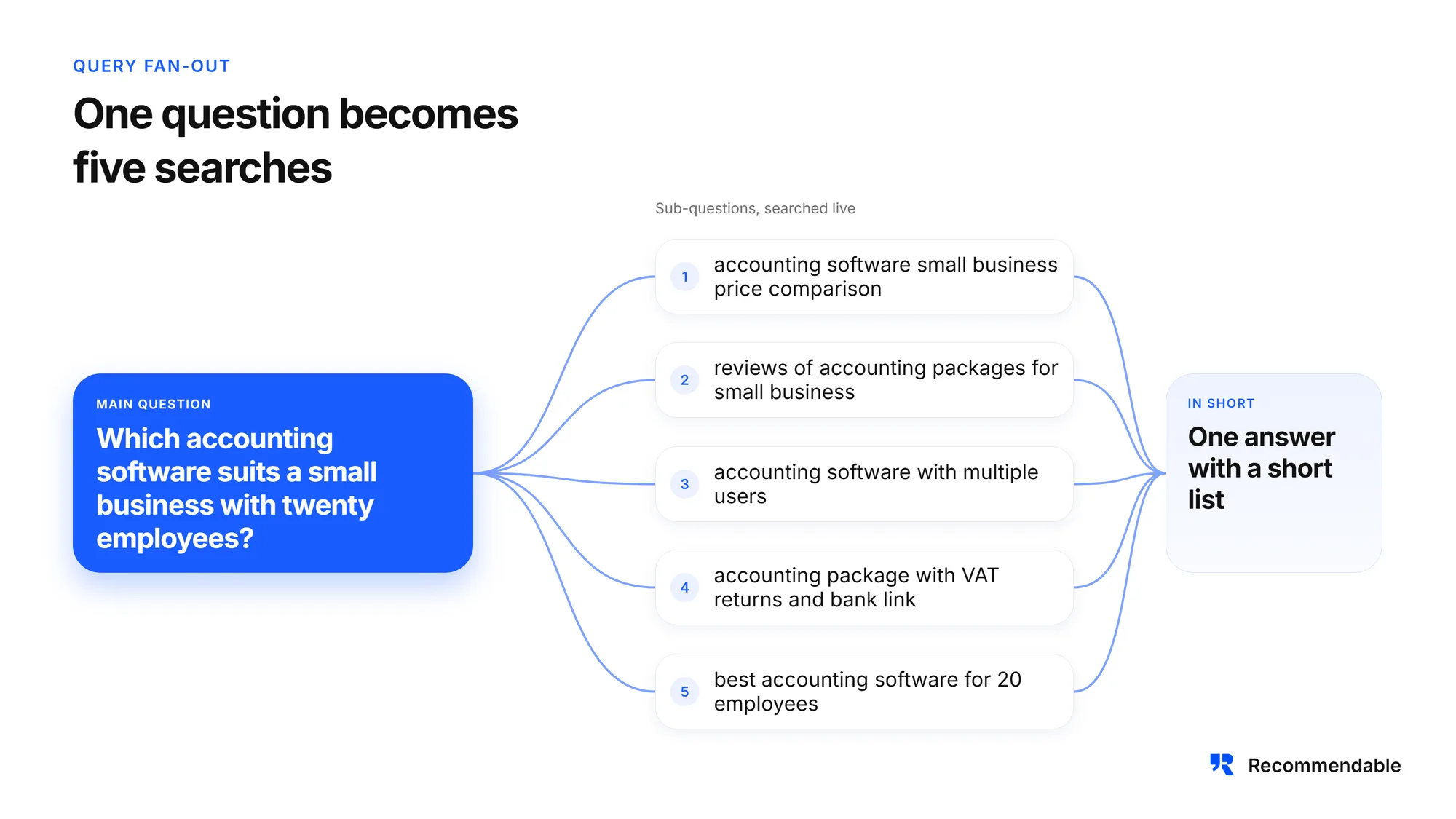
The way they split up those sub-questions can also change every now and then. Ordinary users don’t see these sub-questions, but there are methods, such as plugins and tools, to make them visible after all (Recommendable does that too).
Citations, mentions and recommendations are different things
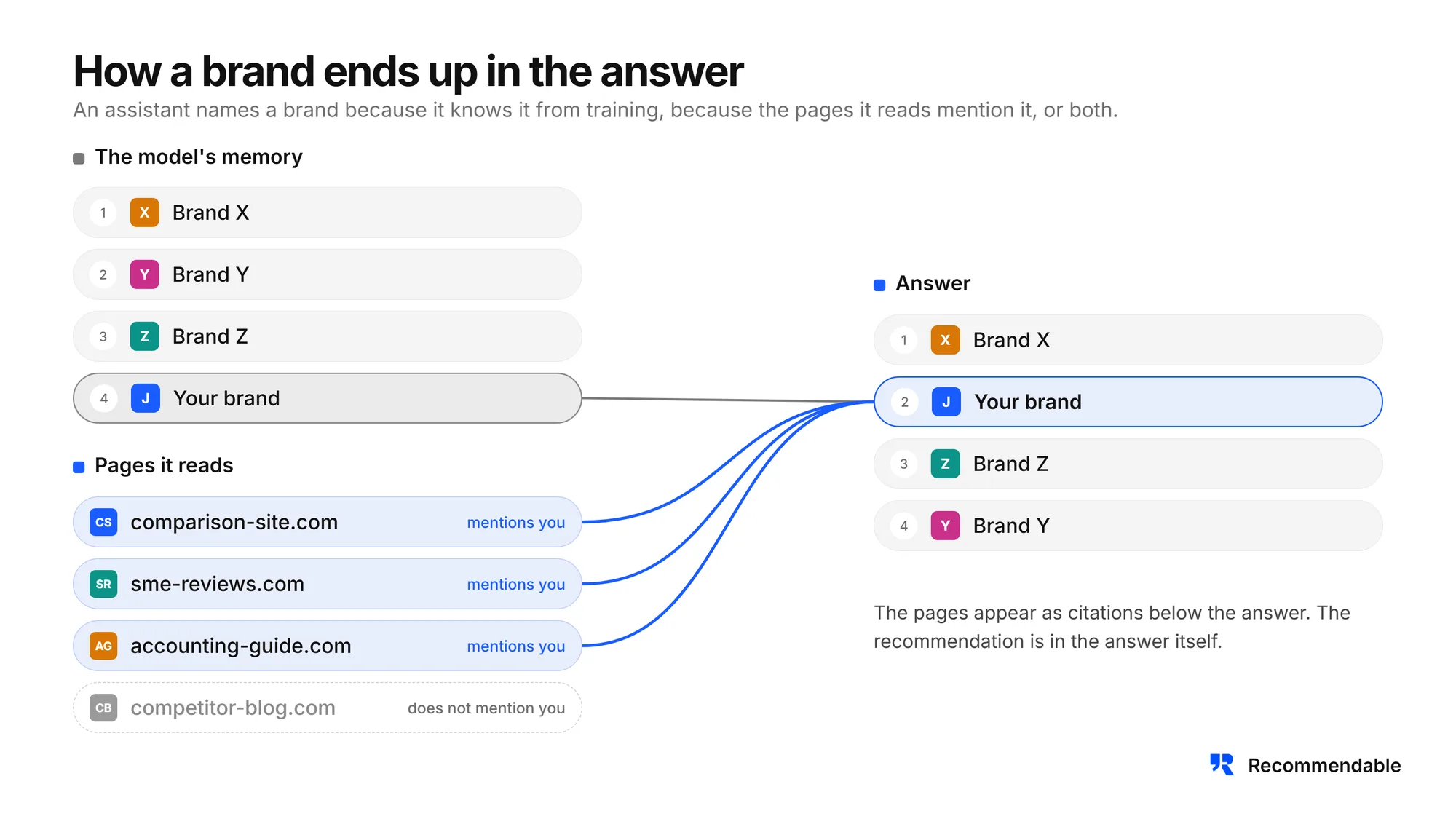
With live search, besides those sub-questions you also get citations: the sources listed below an answer. If the model answers from memory, they aren’t there. Many marketers see how often your site is cited as one of the most important metrics for AI visibility, and many tools report it that way too, but that’s wrong. In my experience hardly anyone clicks on those sources. You already have your answer, and the sources sit somewhere at the bottom or behind a little icon. A citation is nothing more than a source reference.
What you can take from this: a citation is only a means to an end. A GEO tool or provider that shouts they’ll get you cited more often, or builds their whole strategy around it, is optimizing for the wrong goal.
Then there are mentions: these show that your brand is named in the first answer. But what matters are recommendations: are you actively recommended at the end of the conversations as the best option for the user?
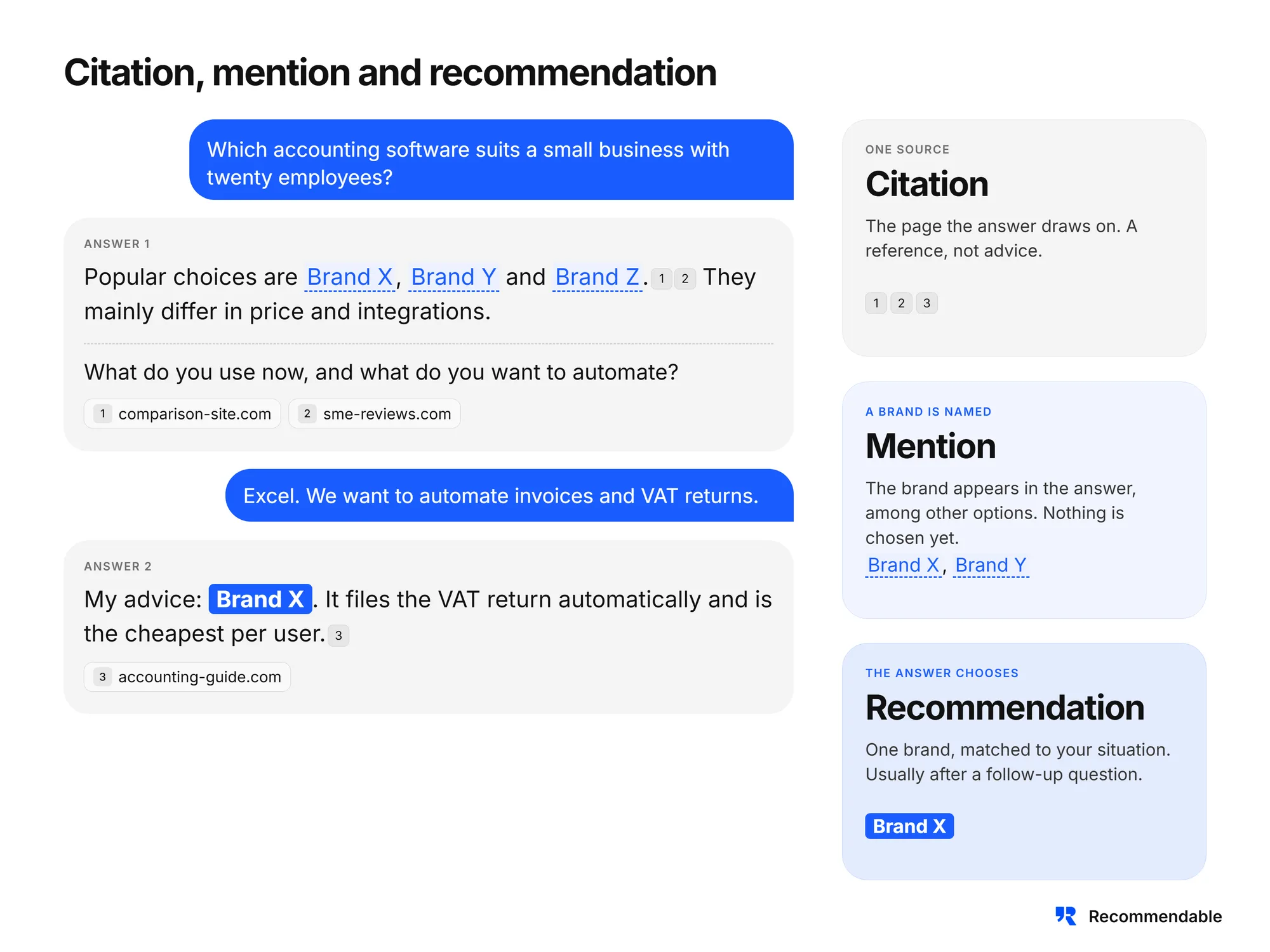
A recommendation sits in the final answer itself, and that’s what you want to achieve. Recommendations come first of all from memory and then from the results of the live searches. Those results can certainly influence the answer, but the citation is only the visible trace of it. Being cited doesn’t mean you’re also recommended.
Why checking once whether you get mentioned tells you little
So how can you tell whether AI recommends your competitors instead of you? Many other articles then give the following advice: test it yourself by asking ChatGPT targeted buying questions, perhaps in incognito mode. But what they forget is that AI is probabilistic, which we talked about earlier. Being mentioned or not once doesn’t say much in itself and doesn’t give a good picture of your performance.
That also leads to one of my biggest criticisms of many GEO tools. They are ‘prompt trackers’: tools that fire a self-chosen collection of prompts at the different models at a fixed interval, tally how often your brand is mentioned in the first answer or your site is cited, and pour that into a slick dashboard. It often looks great, and if they measure daily they show nice trend lines in fancy colors. Impressive at first sight. But appearances deceive. Whether their results are statistically reliable enough to make well-founded statements, they often neither state nor measure.
These are deterministic tools built for a probabilistic platform.
This can be solved. You measure more often and take the variation in answers into account, so you can make statistically reliable statements with a confidence interval. Old-school statistics at its finest. The downside is that measuring costs more, because you retrieve results much more often. But what would you rather have: cheaper but unreliable measurements, or slightly more expensive but reliable ones? I choose the latter.
Being mentioned is nice, but it doesn’t tell you whether you’re also recommended
But even if you always measure correctly, you need to be clear about what you’re measuring. Merely being mentioned in the first answer is very different from being recommended at the end of an entire conversation. People have whole conversations with ChatGPT before they make a choice.
Being mentioned or being citable is nice, but getting recommended more often is what AI Search is really about.
The questions that follow
We started with a high-level understanding of how AI Search works, but then new questions arise naturally, such as:
If AI keeps giving different answers, how can I make statistically reliable statements about my visibility?
How do I score in memory versus in live search, and can I draw insights from that to improve my strategy?
What is my brand’s reputation on the different platforms, and are there big differences between them?
Is everything they think correct, and what do I need to do so that AI has the right image of me in its memory?
How do I see whether AI recommends my competitors instead of me, and for which questions?
How do I make sure I’m not just mentioned in the first answer, but also recommended in the last one? And can that be measured? If so, how?
In short, understanding is followed by depth. I’ll be going deeper on this here more often in the coming time. In part 2 I’ll show what you can do, at a high level, to get recommended more often.
Recommendable answers these questions, and that’s what I’m building it on. The platform researches how AI assistants talk about your brand and whether they recommend you, based on complete conversations, across multiple platforms and with repeated measurements, so you get a reliable picture instead of a chance outcome.

Peter has worked in search and digital strategy since 2008. At Recommendable he researches how AI is fundamentally changing the search landscape and the marketing profession.